Geological Data Acquisition Program and Sample
Repository
 |
Mobile Drill B-31.
The FGS Geological Data Acquisition
Program acquires and archives geological and geophysical data and samples
from outside contractors as well as through in-house operations. The Program
conducts operations in support of existing FGS research, including the
statewide geological mapping program
(STATEMAP),
as well as other DEP programs such as the Department’s Water Resource
Management / Environmental Assessment & Restoration Program, and Florida
Parks. Additionally, the Program provides support for Water Management
District (WMD) and U.S. Geological Survey
hydrogeology projects.
 |
CME-75 rig.
Program capabilities include wireline core drilling in
both unconsolidated and indurated sediments, monitor well installation,
ground penetrating radar (GPR) to help characterize the shallow subsurface,
and borehole geophysics. Resources include three truck-mounted drill rigs, a
1978 Mobile Drill B-31, a 1984 CME-75, and a 2005 Schramm T450MIIA and
associated trailers and support vehicles. The GPR tools include 250, 100 and
50 MHz antennas. Borehole geophysical tools manufactured by Mount Sopris
Instruments include a borehole video probe, caliper probe, gamma/SP/SPR
probe, Temp/FR probe, water quality probe, and a flow-meter probe.
The Florida Geological Survey took delivery of a new Schramm T450MIIA
drill rig during the first week of June 2005. Two drill manufacturers,
Schramm Rotadrills of West Chester, Pennsylvania and Universal Drilling
 |
Schramm T450MIIA rig.
Rigs (UDR) of Australia, partnered to design and build the one of a
kind, state of the art drill. The base of the drill is a Schramm
T450MIIA; the tophead, pipe spinner and hydraulic pipe clamp were
supplied by UDR. The Schramm T450MIIA is mounted on an International
7400 6x6 chassis with a Power Take-Off (PTO) to run the drill. The new
drill has four different pumps: a Gardner Denver 5x6 mud pump, Moyno
3L8, Flowmax centrifugal and a Mission centrifugal pump, all
hydraulically driven. A
Sullair 300/200 air compressor is included for air rotary drilling or well
development. A jib boom that rotates 270 degrees is located at the top of
the 36’ mast with a single 15,000 pound hoist line. A wireline hoist is also
mounted on the backside of the mast with a capacity of 3,200’ of 3/16” cable
for wireline coring operations. Before acquisition of the Schramm, the FGS’s
deep core drilling program used a Failing 1500 rig purchased in 1990. When
the Failing 1500 was new, it had a coring capability of 1,500 feet. However
in recent years, as the rig aged, drillers were limited to a maximum
drilling and coring depth of less than 1,000 feet. The Schramm T450MIIA
allows for a total coring depth of 3,000 feet, more than doubling the total
coring depth capability of the previous drill rig. The Schramm also allows
for safer drilling
 |
FGS water truck.
operations due to better control design and newer
technologies for handling casing and drill rod.
A vital program activity is the maintenance of the FGS
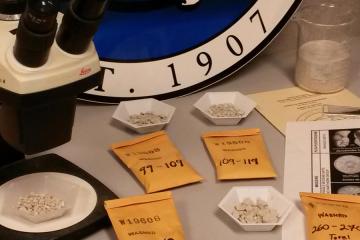
Sample Repository. Program staff receive and
process cores and cuttings from private well contractors, Water Management
Districts and other state agencies, the USGS, and from FGS operations. The
samples are archived in the Repository where they are kept available to
researchers and scientists. Geological Investigations staff describe newly
acquired cuttings and cores and the descriptions are entered into the FGS
lithologic database, which presently contains nearly 5,000 entries. Cores,
cuttings, lithologic descriptions and geophysical logs are an invaluable
asset to the earth science community. This fundamental geologic data
supports needs of more than one third of the programs in the Florida
Department of Environmental Protection. The Geological Investigations staff
also act as consultants to or co-investigators with other local, state and
federal agencies.
FGS Sample Repository
 |
The Florida Geologic Survey (FGS) maintains
collections of well and surface outcrop samples. The well sample collection
contains more than 19,000 sets of samples from exploration, water, and oil
wells. Most wells are represented by sets of drill cuttings. Approximately 1150
wells are represented by continuous core or core samples (a total of
approximately 205,000 feet). The deepest continuous core in Florida, 2,707 feet,
is housed in the FGS repository. The FGS, USGS, Water Management Districts,
drillers and geologic consultants drill new core and cuttings sample sets which
are added to the archives. The sample repository facility occupies 12,090 square
feet, with almost 35,000 cubic feet of shelf space, with room for expansion. |
Location and Contact Information
Hours
By Appointment only
Monday - Friday 8:00 a.m.- 5:00 p.m., Eastern time
Closed all State of Florida Holidays
Location and Shipping Address
Florida Geological Survey
Annex and Warehouse
3915 Commonwealth Blvd Tallahassee, FL 32399-3000
Mailing Address
Geologic Samples Repository
Florida Geological Survey
3900 Commonwealth Blvd MS 725
Tallahassee, FL 32399-3000
Contact
To obtain information about the FGS repository holdings or to
arrange a visit please contact
Ken.M.Campbell@dep.state.fl.us (850).245.3130 or
David.Paul@dep.state.fl.us (850)245.3131
|

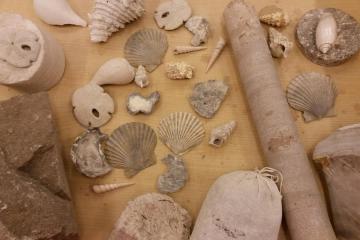
A collection of approximately 5,900 outcrop samples
and mineral specimens is maintained by the FGS at
its headquarters in the Gunter Building, located on
Florida State University’s Campus.
These samples are cross-indexed by formation,
lithology, county and location. The collection is
referred to as the "M-Series." The M-Series is
particularly valuable given Florida's high rate of
growth and development. Surface exposures of
critical lithologies have become inaccessible with
the continued proliferation of roadways, shopping
centers, parking lots and high-rise housing. These
sample archives and the FGS database are utilized by
geologists at the FGS, many other state, federal and
local governmental agencies, universities (both in
and out of the state), geological consultants, well
drillers and the public.
The FGS’s holdings also includes a collection of
thin sections and geophysical logs. A complete
listing of these items is available on request.
In order to make arrangements to view our sample
collection, please contact one of the geologists,
assistant state geologist or the acting director. A
list of contacts can be found here in
contacts. All requests to take samples require
advanced notice and approval. The guidelines and
request forms can be downloaded here
FGS Sampling Proposal Guidelines
. While we are able to provide work space and
microscopes, visitors are suggested to bring their
own sampling materials such as: camera, sample bags,
markers, hand lenses, flash lights, brushes, hand
picks, gloves, face mask for those who might be
susceptible to mold and dust, hand cleaner, etc.
If you are sending samples to the FGS please fill
out and include a copy of our
well sample forms
The FGS is a participant in the National
Geological and Geophysical Data Preservation Program
(NGGDPP). For more information about Geological
sample preservation and repositories, see the
brochure developed by the
American Association of Petroleum Geologists,(AAPG)
Preservation of Geoscience Data. |
 |
Well Sample Forms |
|
 |
|
 |
|
Current Program Projects
-
Coring support for FY 09/10 STATEMAP project – Geologic Map of the
Western Portion of the USGS 30 x 60 Minute Ocala Quadrangle
-
Suwannee River Springshed Delineation Project
- Arsenic and Trace Metals in Groundwater Project
- USGS / Broward County ASR study
- CME-75 refit
Proposed Projects
National Geologic and Geophysical Data Preservation Program (NGGDPP) –
The FGS has proposed to bar-code the entire Sample Collection Repository. A
significant aspect of the project will be the hands-on inspection and
verification of the samples to include information such as the total sample
intervals and missing intervals. The bar-coding will result in a more
user-friendly inventory check in / checkout process as well as maintain
information about where checked-out samples are and who has them. Finally,
the system will enable better evaluation of how the samples are used by the
scientific community.
|