
|
The Florida Aquifer Storage and Recovery Geochemical Study is an ongoing investigation by the FGS to examine
water-rock geochemical interactions that take place during ASR cycle testing. Water-quality variations and aquifer
system characteristics at five ASR facilities are the focus of the current study. In addition, geochemical and mineralogical
data from cores taken within and outside the influence of an ASR storage zone is currently being collected.
FGS research funded by the FDEP UIC Program (Division of Water Resource Management) has confirmed that understanding
water-rock geochemical interactions is important to the continued success of ASR in Florida. Results of this investigation indicate
the following: 1) chemical (including isotopic) variability exists within ground water and carbonates of the Floridan Aquifer
System, 2) this variability may result in site-specific geochemical processes affecting ASR wells and water quality, 3) in some
localities, oxygen-rich surface waters, once injected into the Floridan Aquifer System causes the release of trace metals such as
arsenic (As), iron (Fe), manganese (Mn), uranium (U) and perhaps nickel (Ni) into the recharged (and eventually recovered) waters,
4) the design of recharge-storage-recovery cycle tests and the location of monitor wells are important aspects of understanding
these geochemical processes. Of the nine cycle tests investigated to date, most recovered samples exceed the new maximum
contaminant level (MCL) for As (10 ug/l). Research on the source of As in the Floridan Aquifer System matrix, results of cycle
testing in different hydrogeological settings and the effects of repeated cycles tests continues. See also http://water.usgs.gov/ogw/pubs/ofr0289/jda_mobilization.htm
The FGS is also engaged in research as part of the Comprehensive Everglades Restoration Plan to conduct a geochemical
reconnaissance of the Floridan Aquifer System carbonates in southern Florida. This investigation will focus on
carbonate mineralogy, mineral chemistry, rock geochemistry (including a series of isotopic analyses), and bench-scale
studies. Two types of bench scale studies are underway: sequential extraction, which identifies associations between
minerals and metals, and leaching studies that assess solubility of metals during simulated cycle tests under
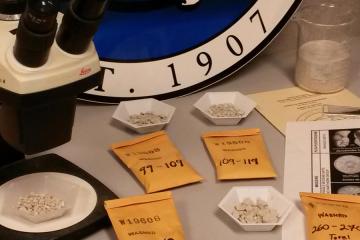
high-dissolved oxygen conditions in the laboratory. Similar experiments are being conducted for consulting firms,
who have recognized the expertise and the unique analytical capabilities of the FGS hydrogeochemistry lab (see
figure at right).
Results of this research underscore the need for continued research on the geochemistry of ASR in Florida,
especially in consideration of the proposed 300 ASR wells to be installed as part of the
Comprehensive Everglades Restoration Plan. There exists a need to improve our understanding of
the water-rock dynamics in different hydrogeological settings in which ASR may be applied.
(Cooperative research with Camp, Dresser and McKee, Inc.)
The purpose of this study is to characterize bench-scale leachability of Floridian Aquifer System carbonate rocks in
response to high concentrations of dissolve oxygen (DO), and identify sources of metals in these rocks.
This study is divided into five main parts:1) lithological descriptions of the ASR well rock samples of Avon
Park Formation, Seminole County, 2) permeability study for both vertical and horizontal core samples of the
ASR well, 3) geochemistry of the water samples (leachate) when exposed to aquifer rocks under high concentrations
of dissolved oxygen, 4) geochemistry of the aquifer rocks to identify sources of metals in these rocks, and 5) sequential
extraction of the storage-zone carbonates to identify mineral and non-mineral phases in the aquifer matrix that may be leachable under ASR conditions.
Four hundred sixty five water samples, seven whole rock samples, and seven
sequential leaching samples have been analyzed for 64 elements using ICP-MS and ICP-OES analytical
techniques (Activation Laboratories).
|
|
Water quality changes during the four bench-scale cycles have been evaluated.
Time-series graphs allow comparison of water chemistry changes during periods of aeration and
non-aeration for each cycle. The graphs (see example below) also clearly define concentrations
and mobilization, depending on the initial concentrations of the source rock. Mobilization of As,
U and other trace metals during four cycles for the Seminole ASR aquifer rocks is evident.
Comparable results for leached As were evident in all four cycle tests. Leachates collected from
cycle test 1 displayed greater As concentrations compared to the other three cycles. During this
cycle, leachates collected during pump off showed an increase of As concentrations with time
whereas during pump on, As peaked, then showed decrease in concentrations with time. On the other
hand, other samples showed more than one As peak.
From the whole rock geochemistry data, many trace metals such as As, Cr, Ni, V, Mo,
and U showed high concentrations, when compared to global averages for limestones. Linear covariations
of As and Mo suggest that Mo is possibly associated in As-bearing phases such as arsenian pyrite or organic
material. Other minerals or phases containing As in these carbonate rocks include organic material and
Fe- and Mn-oxyhydroxide coatings. Arsenian pyrite is among the sources of As in the ASR aquifer rocks,
however, sequential extraction studies suggest other phases (e.g., Fe-oxides and organics) may contain As
and associate metals as well. Organic material may contain U, which is also thought to be associated with
carbonate phases.
Results of sequential extraction bench tests suggest that dominant As-bearing phases
reside within the “organic plus insoluble residue” fraction of the matrix, which includes sulfide minerals
(see below). Results demonstrate that the “organic plus insoluble residue” fraction is strongly associated
with Al, Cd, Cr, Co, Fe, La, Ni, Pb, Se, Sr, Th and U, whereas Zn is associated with carbonate minerals.
Organic material is recognized as a source/sink for uranium. The sources of arsenic may also include
organics in addition to pyrite. These extraction results also provide evidence for presence of As and other
mobilized metals in “non-sulfide” fractions of the aquifer matrix (e.g., the carbonate and Fe-oxide fractions
).
The Hydrogeology Section acquired new lab space at the FGS/DEP annex. The hydrogeochemistry
lab (525 sq. ft.) is ready for operation with an additional 95 sq. ft. for sample storage. A radio-isotope
lab of 209 sq. ft. is equipped with an alpha spectrometer and a radio-isotope fume hood. This will be used
for uranium isotope studies of groundwater. A Mega Pure 3A Water Still will accommodate analytical water
needs. Seventy-six feet of bench space is available for laboratory experiments such as bench-scale leaching
and extraction studies of water-rock interaction related to aquifer storage and recovery (ASR)
The Hydrogeology Section has also acquired a scanning electron microscope JXA-840A (SEM)
and microprobe. The SEM lab is approximately 277 sq. ft. located adjacent to the hydrogeochemistry lab.
This instrument can be used for many applications in mineral chemistry, as well as paleontology. Current
investigations are utilizing the state-of-the-art high performance electron probe microanalyzer that allows
high resolution element mapping and analysis. The microprobe is an energy-dispersive x-ray system with a
light-element window (can detect elements as light as boron) coupled with a 4-Pi Revolution imaging and
analyses computer system. Discussions are underway to add and wavelength dispersive detector to the SEM.
Selected Outsourced Research Projects
- Surface geophysical methods demonstration project designed to define the extent of ASR injection zones (in 3-D, time transgressive) to improve monitor well placement at ASR facilities
- Bench-scale microcosm studies to simulate and better understand ASR microbiological- geochemical reactions (planned)
- Characterize baseline indigenous microbial populations (genetics and physiology) in receiving aquifers at ASR facilities to further understanding of the affect on water quality and microbial fate and transport
For more information about ASR Hydrogeochemical Research, contact Jon Arthur.
|