Management Issues
The "Management Plan for the Integrated Habitat Network: Lease
Nos. 3963 and 3995" was originally published in 2002. Five
significant issues affected the tracts of land leased to or being
monitored by the BMR. Since then, the BMR staff has identified a sixth
issue, which will be addressed in this management plan revision. Since
these issues also pertain to other tracts within the IHN not leased to
the BMR, they either have been or will need to be addressed in those
areas as well. These issues are:
- Undefined property boundaries, restricted site access, and
continuing infringement from off-site sources on leased lands;
- Unknown types and locations of renewable and non-renewable
resources on leased lands;
- Existence of hazardous conditions and associated safety concerns
due to previous on-site mining activity;
- Absence of guidelines for optimal development for environmental
and economical use of leased lands;
- Lack of public awareness and use of the Integrated Habitat
Network/Coordinated Development Area; and,
- Incorporating the IHN concept into land use review processes of
other agencies.
BMR land management staff at the Homeland Office has made significant
progress in addressing and resolving these management issues during the
past several years. The BMR’s updated plans to address these management
issues on its leased properties and other areas within the IHN are
outlined below.
Issue 1: Definition and Protection of Property in IHN
When the IHN management plan was first published in 2002, property
boundaries around most of the BMR-managed tracts had not been
delineated, marked by signs, or fenced. Access onto many of these
properties was obstructed or non-existent. Encroachment from adjacent
landowners and individuals was a common occurrence. The BMR’s initial
needs upon acquisition of these leases were the definition and
protection of property boundaries.
A land surveying company under state contract with the DSL was
engaged in 2002 to survey property boundaries of the BMR-managed IHN
lands. To date, boundary delineation has been completed in the majority
of the BMR-managed Coastal Settlement tracts on the North Prong of the
Alafia River and the Peace River . For those BMR-leased tracts where
property definition has not yet been completed, BMR staff will continue
to assess the need for delineation and ensure this work is completed
within the next few years by private firms under contract with the DSL.
Signs stating Integrated Habitat Network lands are "Managed for
the Environment in Cooperation with Landowners" were designed and
produced in 2002. These signs have been installed along the boundaries
of the following BMR-managed Coastal Settlement tracts: Little Payne
Creek, North Prong of the Alafia River , Clear Springs, and Homeland.
BMR staff will continue to install or supervise the installation of
markers denoting those areas as part of the Integrated Habitat Network
along property boundaries accessible by the public.
BMR staff has coordinated with adjacent landowners and has made
significant progress in improving access to IHN lands where it was
previously limited or non-existent in order to carry out management and
monitoring activities. In areas where unauthorized access to BMR-leased
lands has been or continues to be a problem, fencing has been installed
or repaired and/or security gates and locks installed at access points.
BMR staff will continue to conduct frequent inspections of tracts to
detect unauthorized infringements and will continue to work with the
FFWCC, the Polk County Sheriff’s Office, and DEP’s Division of Law
Enforcement in the investigation and prosecution of any illegal
encroachment on these parcels of land.
Issue 2: Definition And Protection Of Resources Within IHN
Distinct archaeological or historical resources, outstanding or
unique natural features, atypical soils or minerals, diverse water
resources, and listed animal or plant species and the habitats that
might support them are all likely to be present on the IHN lands.
However, in the absence of more definitive field surveys and data
reviews, the existence, extent, and location of these resources could
only be speculated. More definitive information about any existing
non-renewable and renewable resources was needed for the development of
specific guidelines in the conservation and preservation of these
assets.
BMR staff began to address this issue in 2003 using GIS/GPS to
comprehensively map locations of exotic plant infestations, water
sources, archaeological features, potential habitats of listed species,
and other points of interest relative to the management of the property.
Archaeological/Historical
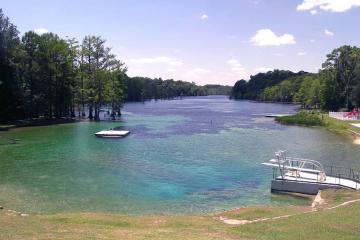
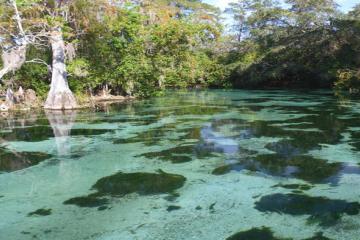
he field surveys and resource mapping have revealed several
interesting discoveries within the BMR-managed IHN tracts. One of these
sites is Kissengen Spring, located on the west side of the Peace River
south of Bartow. Flow from the spring ceased many years ago but an
upwelling appeared in Kissengen Spring in January 2006 and remained
visible for several weeks after. Though the exact cause of this “boil”
is as yet undetermined, the BMR will continue to assist the U.S.
Geological Survey (“USGS”), SWFWMD, and Polk County with the
investigation of this phenomenon. The second historical resource site
was discovered by BMR staff in 2004 and later added to the Department of
State’s Master Site File. The site is a rock weir constructed by Native
Americans (probably used to concentrate fish for harvesting) located on
the Peace River in the vicinity of Ft. Meade.
To date, resource mapping in the northern tract of the Peace River
has been completed on the areas designated Clear Springs and Homeland
tracts. Resource mapping will continue in other BMR-managed lands within
the IHN. BMR staff will continue to work with the DHR and other agencies
in the conservation and preservation of archaeological/historical
resources and outstanding/unique natural features on IHN lands.
Outstanding/Unique Natural Features
Although there is little possibility of outstanding native landscapes
with relatively unaltered flora, fauna, or geological conditions on the
BMR-managed leases, the BMR will continue to conduct field surveys and
database reviews of its leases to identify and locate any remnant
communities, populations, or natural features that may have gone
undetected up until now. The BMR will emphasize the protection and
preservation of any outstanding or unique natural features that
currently exist or which may be found on IHN lands within the realm of
this management plan. Any outstanding and unique natural features on
lands being considered for lease to the DEP/BMR will be protected
through the Environmental Resource Permit process and the long-term
maintenance and protection mechanisms arising from this process.
Soils/Minerals and Water
Plans to protect and conserve land and water resources on the IHN
need to incorporate aspects for both natural, undisturbed areas as well
as those for mined, disturbed lands. Best Management Practices currently
exist for the management of many natural areas and agricultural lands,
but BMPs and site-specific management guidelines for reclaimed lands
still need to be addressed and developed.
SWFWMD began Total Maximum Daily Load and Minimum Flows and Levels
studies as well as exploring other research endeavors on the Upper Peace
River hydrology in late 2003. BMR land management staff joined with
SWFWMD, the USGS, and the DEP Bureau of Watershed Management in this
effort. BMR staff also assisted Charlotte Harbor National Estuary
Program, SWFWMD, and Polk County Natural Resources in the collection of
water samples from area tributaries in the aftermath of Hurricane
Charley to study flow patterns and water quality differences of surface
and groundwater along the Peace River . The BMR also plans to coordinate
with agencies such as U. S. Department of Agriculture-Natural Resources
Conservation Service (“NRCS”), soil and water conservation districts,
water management districts, and cooperative extension services regarding
BMPs for soil erosion control and water resource management. By working
with cooperative extension services to determine Integrated Pest
Management Programs for lands within the IHN, BMR staff will be able to
employ BMPs for pesticide and fertilizer use on BMR-managed lands to
minimize or avoid adverse impacts to surface and ground waters.
Appropriate water conservation BMPs will also be used on individual
tracts of IHN, as needed. Information collected from these studies will
be incorporated into the Peace River Cumulative Impact Study/Resource
Management Plan, currently under development by the BMR in conjunction
with SWFWMD.
Vegetation/Land Uses and Fish/Wildlife
In August 2005 the FFWCC and DEP executed a Memorandum of Agreement
(“MOA”) for the coordination of conservation issues related to
permitting, reclamation and management on lands affected by mining.
Under this MOA, these two agencies will work together to conserve and
protect water resources and wildlife within the IHN. While maintenance
and enhancement activities such as prescribed fires, exotic species
control, and planting food species for wildlife have been performed by
these agencies in the past, the MOA will increase the efficacy of
management activities aimed toward improving habitats for wildlife. A
link to this document is available on http://www.dep.state.fl.us/water/mines/ihn/index.htm.
Several threatened and regionally rare species have been found on IHN
lands by BMR staff during its resource surveying efforts. BMR staff will
continue to carry out resource mapping and surveying on IHN lands to
obtain more information about existing resources and use it to develop
adequate guidelines and schedules for maintenance and enhancement
activities needed to protect and preserve these resources.
Issue 3: Improvements to Impacted Areas Within IHN
Phosphate mining began in central Florida in 1800’s and several of
the parcels in the Integrated Habitat Network have been impacted at one
time or another by mining or mining-related activities. Mining debris is
still present on some of these properties and presents safety concerns
for the public and impediments to beneficial wildlife habitat. Lands
mined prior to July 1, 1975 were not required by the State to be
reclaimed and there are areas within the IHN in this condition. Some of
the mined or disturbed areas that were reclaimed but not actively
managed since their release from State reclamation requirements have
become dominated by nuisance or exotic species.
A major effort to reclaim one of these impacted areas is currently
underway on the BMR-managed Homeland tract. An Environmental Resource
Permit was issued to the DWRM by SWFWMD in 2003 to initiate reclamation
activities on Nonmandatory Reclamation Parcel MCC-FM-06. Testing of
surface water leaving MCC-FM-06 began in the summer of 2003 and work has
progressed to the point where earthmoving and revegetation are well
underway. By early 2006, earthmoving activities in this parcel were
approximately 80% complete; reclamation activities in this parcel are
expected to be completed in the near future.
The restoration of the ecological and hydrological functions in the
heavily mined Saddle Creek and the Upper Peace River watershed is
another ambitious project initiated by the BMR. In 1995, a Memorandum of
Understanding, signed by the DEP, U.S. Army Corps of Engineers, SWFWMD,
DOT, and Florida Game and Freshwater Fish Commission (now the FFWCC),
was the impetus for the project. Of the four potential alternatives
originally considered, one was eventually selected following the
completion of modeling studies as the route for surface water flow
through the Tenoroc Fish Management Area. Deemed a key element in the
success of the restoration project, surface water flow will be of
paramount importance in the selection, placement and success of
mitigation wetlands at TFMA and the completion of reclamation activities
on various Nonmandatory Reclamation Programs at the site (details can be
seen at
www.dep.state.fl.us/water/mines/upr/index.htm).
A contract with a private company was executed with the State on June
26, 1998; reclamation activities have been underway since then and are
expected to be completed within the next several years.
In other areas of the IHN, BMR staff has mapped the location of old
mining debris along portions of the Peace River and worked with
phosphate companies to enhance the property by removing the debris from
several areas. BMR staff will continue to work with landowners,
consultants, phosphate industry representatives, and other agency
personnel to determine areas in need of reclamation, potential sources
of funding for reclamation activities, and in the development of
reclamation plans for those areas in the IHN with secured funding.
Issue 4: Development of BMPs for IHN/CDA Lands
Management plans to protect and conserve land resources on the IHN
need to incorporate aspects for both natural, undisturbed areas as well
as those for mined or disturbed lands. It has become apparent that
existing BMPs for unmined lands, such as those for forests, cattle,
construction, citrus, water quality, etc. are inadequate when applied to
mined and reclaimed lands, especially those reclaimed for environmental
purposes. The massive impacts that occur in an area during phosphate
mining can significantly hamper the success of reclamation efforts.
Soils are drastically altered through the removal of natural soil layers
and the introduction of waste sands or clays, important soil
microorganisms are depleted or destroyed, and wetlands, streams, and
water bodies that were eliminated or severely impacted by mining
activities are likely replaced by mine pits or created wetlands and
water bodies with different substrates, drainage patterns, and
locations. BMPs designed specifically for mined lands reclaimed for
environmental and agricultural purposes need to be developed, tested,
and compiled for use throughout the phosphate mining district in order
to better protect IHN lands.
The BMR has been working with various entities in the development of
BMPs for mined lands reclaimed to environmental habitats, including:
- Coordinating the planning of prescribed burns with owners of
lands adjacent to the North Peace River tract to better manage the
reclaimed shrub marsh and floodplain forest;
- Cooperating with the NRCS, University of Florida-Institute of
Food and Agricultural Sciences (“IFAS”), area native plant
nurseries, Florida Native Plant Society, and various phosphate
companies regarding the construction and operation of a native plant
nursery at the Homeland tract to study and develop native species to
be used in phosphate mine reclamation;
- Supporting Florida Institute of Phosphate Research (“FIPR”) and
IFAS staff in the development of a study on the interaction between
native plants and cogongrass in a former clay settling area;
- Improving wildlife corridor functionality in conjunction with
greenways used for recreational purposes;
- Coordinating with FFWCC, FIPR, DOT, IFAS, and the U.S. Fish and
Wildlife Service to determine enhancement actions, such as the
planting of native food and cover species, the control of nuisance
and exotic species, appropriate use of pesticides and fertilizers,
etc. on reclaimed lands;
- Encouraging research on wildlife on reclaimed lands, headwaters
and hydrology restoration, etc.; and,
- Continuing efforts at Homeland to promote the use of native
vegetation through the development of its nursery for the
propagation of native plant seeds and seedlings and offering the
plant material to phosphate companies for use on reclamation
projects.
BMR staff will continue with these efforts and initiate others to
further the development of these BMPs for lands reclaimed to
environmental and agricultural/silvicultural uses.
While some phosphate mined land is reclaimed to environmental land
use, the majority is reclaimed to an agricultural land use. The BMR has
been promoting research on lands reclaimed for agricultural purposes
through coordinated efforts with other groups, including:
- Assisting researchers from IFAS with a study of vegetation
filter strips at the Homeland tract;
- Supporting FIPR and IFAS staff research on commercial tree crops
on phosphate-mined lands on a clay settling area near the Homeland
tract (http://trees.ifas.ufl.edu);
and,
- Working with the Federal Emergency Management Agency, the city
of Bartow , and Polk County in the use of mulch from hurricane storm
debris by incorporating it as a soil amendment.
Since the predominant post-reclamation land use is
agriculture-related, the BMR began promoting in 2002 the development of
a Mined Lands Agricultural Research and Education Center (“MLRC”) to
address various uses of reclaimed lands for semi-intensive and intensive
agriculture. Proposed research would include appropriate cattle stocking
rates, grazing management, the use of controlled grazing/prescribed
fire/integrated pest management, and other areas of interest in
agricultural-related uses of reclaimed lands. The MLRC would be
developed as a reclamation and environmental education facility that
could be used to develop BMPs for phosphate mine reclamation activities,
serve to educate the public about the phosphate industry, and serve as
part of a larger regional environmental education center (proposed
research into agricultural uses on reclaimed lands would be conducted
with the attainment of Minimum Flows and Levels, Water Conservation and
Re-Use, Total Minimum Daily Limits, and nutrient recycling as the
primary objectives). In early 2006, the mined lands research center is
in initial development; documents by the MLRC Ad Hoc Committee are
available through links on http://www.dep.state.fl.us/water/mines/ihn/index.htm.
Issue 5: Public Awareness and use of IHN/CDA Lands
Since the inception of the Integrated Habitat Network management plan
in 2002, the BMR has expended a great deal of effort in promoting the
idea to industry representatives, agency employees, and environmental
groups. BMR staff has joined with representatives from other agencies to
offer meetings, visual displays, documents, lectures, field trips, etc.
in an effort to increase the general public’s knowledge and
understanding about the IHN concerns, needs, and accomplishments.
Several examples include:
- Participating in numerous festivals and educational
demonstrations throughout the area to inform attendees of the IHN
and BMR management practices;
- Publishing "Reclamation-Mitigation-Management Methodologies
and Topics for Mined Lands: Volume 1" to increase comprehensive
knowledge of land management issues;
- Giving presentations to interested parties at schools,
environmental groups, government agencies, industry representatives,
etc. about the IHN;
- Producing and maintaining a website with periodic updates of
management goals, issues, and activities within the BMR-managed
portions of the IHN; and,
- Hosting field and canoe trips along the Peace River to educate
groups about the work being done by the BMR along the river and
acquaint them with the IHN concept.
Future educational efforts might include organizing volunteers to
assist with resource management projects on BMR-leased lands, such as
conducting resource inventories, monitoring vegetation or wildlife
population changes in response to management activities, mapping
exotic/nuisance species, etc. BMR assistance with other avenues of
environmental education, such as creating information kiosks for trails,
assisting with field trips, offering presentations, etc., would also
serve to promote the IHN concept to the public. Promoting programs that
provide funding for organizations which create/maintain greenways and
trails systems with in-kind services and volunteer hours, such as the
Recreational Trails Program, DuPont Awards Program, the Forest Service’s
Florida National Scenic Trail cost-share program, Florida Recreational
Development Assistance Program, etc. would serve to promote the IHN.
Developing volunteer organizations with the Florida Trail Association,
the Florida Canoe and Kayak Association, the Audubon Society, etc. to
construct and maintain areas to be used by the public would also give
the BMR a means to educate the public about the IHN concept.
While the main focus of the management plan is on maintaining lands
for wildlife habitat, water quality and quantity, and riparian
connections, there is also interest in providing limited areas of the
IHN for public use. Except for portions of the Alafia River State
Recreation Area tract, the current level of public use in the IHN is
extremely low. Numerous areas, such as the sensitive floodplain
wetlands, lands that may contain archaeological or historical resources,
wildlife habitat, or geological sites, will not be able to support
unrestricted public use. Other areas contain unconsolidated clays, mine
debris, or unreclaimed lands that would make them unsafe for public use
in their present condition. However, under certain conditions, some
areas may be capable of supporting recreational, educational, and
limited agricultural activities. Until it can be determined exactly what
resources and conditions exist on these lands, it is in the best
interests of the public and the State to restrict recreational use on
the BMR-leased lands. Restrictions and requirements of leases and
agreements, the type and extent of proposed public use, and results of
vegetation and wildlife surveys would be used in the determinations for
or against public use on a parcel of land. The DEP is aware of the need
to facilitate public access to State lands in portions of the IHN,
provided that this increased use does not compromise the original
conservation intent of the IHN property. As the need for more
human-intensive uses of these lands increases, the BMR will work with
land management agencies to ensure compatibility of use and may
relinquish management of portions of the IHN as appropriate on a
site-specific basis. The BMR has worked with local government land
acquisition departments regarding priority lists for acquisitions that
will simultaneously benefit the county and the IHN. The BMR is also
coordinating with local organizations and agencies in the development of
Nonmandatory Reclamation Program lands for horseback, off-road
bicycling, all-terrain vehicles, and other high impact public
recreational uses.
Issue 6: IHN/CDA Concept Included in Agency Reviews
Current emphasis in the State is to increase coordination among the
various government agencies involved in permit reviews, with the goal
being to eliminate duplicate efforts, present uniform permit
requirements to stakeholders, and improve efforts at natural resource
conservation, reclamation, land use, etc. through enhanced policies and
regulations. Legislative initiatives and cooperative efforts between
local, county, state, federal, and regional agencies have resulted in a
more comprehensive view of conservation and protection of IHN/CDA lands
beyond the wetland permitting and reclamation emphasis that occurred in
the past. Cumulative impact studies are determining changes that have
occurred in the southern phosphate mining district, primarily as a
result of agriculture, mining, and urbanization, and the efficacy of
previous and current regulatory and non-regulatory efforts. Resource
management plans are being produced that can lead to recommendations for
an improved regulatory framework that will minimize or eliminate these
adverse impacts to the environment. Consistency in the regulatory and
non-regulatory requirements will make the public better able to
understand the need for such legislation as well as more willing to
comply or assist with the protection efforts.